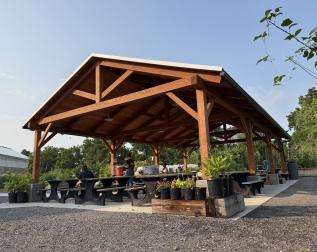

The New Energy Works team recently contributed our high craft abilities to raise an exceptional structure in Buffalo, NY. The Stuart Gellman Family Pavilion is phase one of Hospice and Palliative Care Buffalo’s Pathways of Remembrance campaign.
Kevin V. Connors, PE, AIA, CPHD, and Principal of eco_logic STUDIO, architecture & engineering, PLLC says, “The whole concept of the original development of the project was to maximize a contact with nature for patients, families, and staff, so this, this project is kind of like it's like a trailhead or a boardwalk system that's going to go through the woods. The pavilion really helps to enhance that aspect of it.”
The landscape designer who was working with the center, Ben Hirsch from Beautiful River Landscape Design presented the conceptual architectural language that got the ideas started while eco_logic took over the design.
Conners says, “They desired a way to kind of develop the natural land that they have out there. They've got several acres of wetlands and woods and we kind of picked up where Hirsch left off and developed it into, kind of an architectural concept, as well as the siting and the size of it.”
“It’s a really tight spot. We had to work outside of the wetland area. So, you know, we come right up to the wetland with we've got perimeter rain gardens and rain chains from the gutters going into the rain gardens and then that overflows into the wetlands at one of the corners of the building. They had some space behind the Wilson Center. We oriented the building 90 degrees to the Wilson Center. So, there's a clear kind of relationship there. And it provides enclosure for the outdoor space that wasn't there before.
Through a fulfilling collaboration with Buffalo Hospice and Palliative Care Buffalo, eco_logic, and Buffalo Construction Consultants, a singular and contemplative space was developed. A space for both patients, workers and families, to gain a respectful respite from their trials, whether related to work or loss. It will also be a place for celebration and hope in the face of such trials.
Connors says, “We worked with hospice. We wanted to find out what their program was and what kind of events they wanted to. It started out a little larger than what we have now. This was kind of the sweet spot in terms of, what they can accommodate out there, what their needs are, what their, their budget is.”
Connors recalls, “It's sited in a way that they can have a big event ,that they do right on campus called “Late of Life,” which have the holiday time. People will purchase a card with their loved one's name on it, and it goes on a Christmas tree that they bring in and install on that property. For an event like that, they could have several hundred people. So, the pavilion is sited and kind of graded so that the landscape becomes an overflow around the building on the front side. People can be in it and also outside looking in on any kind of a presentation that may take place there.”
New Energy Works came into the equation through our previous relationship with eco-logic and our love of building not only bespoke structures, but lyrical frames that tell a story and that are as powerful as the places they will inhabit and the people that will visit them.
Connors says, “I think wood was kind of the first thing that we jumped to because we've done the two projects with New Energy Works, the Inclusion in Motion Pavilion in Canandaigua and the carousel project in Buffalo. They're just stunning projects, both of them. So, we naturally thought of New Energy Works and going with timber. It’s not foreign to the surroundings and sort of the architectural vocabulary. It's a kind of comfortable little bit of a craftsman influence. It fits in with that pretty well.”
Scott Pitek, Project Designer and Manager at eco_logic agrees, “The use of timber fit with the context, with it being along nestled on the edge of the woods and wetlands, more fitting with the natural surroundings.”
The Stuart Gellman Family Pavilion’s timber design assimilates into its pastoral landscape while eliciting a biophilic feel. The structure is tinged with a light Oriental aesthetic through its large overhangs and roof lines providing an additional feeling of Zen. The combination of location, nature, and therapeutic design intent collaborate to create a multipurpose pavilion that acts all at once as a tribute, shelter, and personal sanctuary for employees, family, and friends.
Please contact the Hospice Foundation if you would like to learn more about the Pathways of Remembrance campaign here.