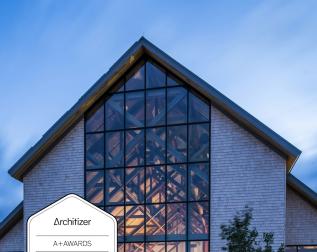

The 27.7 million dollar Acadia Gateway Center is complete after four decades of planning. This stunning and substantial heavy timber entrance to one of the United States most beloved National Parks is the contributions of several partners and funding from private and public support including Friends of Acadia.

With 300 parking spaces, 8 of them electric and 10 oversized, the purpose of the Acadia Gateway Center is to relieve the wear on the park from over 1.86 million visitors this year so far. “It’s a combination of providing a place of entrance and a first look of ‘hey, you’re coming to a great place in Maine.’ And, you also have options for transportation where you don’t necessarily need to drive,” Jarod Farn-Guillette, Region 4 & 5 planner for the Maine Department of Transportation, told Spectrum News. “It’s really a transit hub for locals and people visiting the great state of Maine.”
“Part of the goal of this is to mitigate traffic volumes on State Route Three into Bar Harbor and Mount Desert Island,” continues Farn-Guillette. “But also, to showcase that there’s much to do in the larger region.”
The planning process for the building began back in 2002. “It’s one of the highlights of my 40-year career for sure because it’s been so long in the making,” says John Kelly, Management Associate at Acadia National Park. “It’s such a complicated mix of partnerships and funding sources and efforts that had to be made to get it built.”
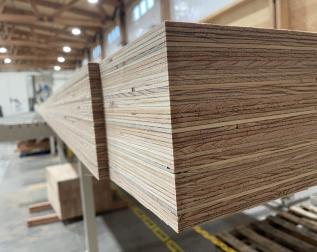
New Energy Works fabricated and installed the solid heavy timber and curved glulam structure. “We had about 460 individual timbers in the timber frame, which equates to about 85,000 board feet of material,” shares Owen MacDonald, director of mass timber at the New Energy Works Farmington Office.
The 11,000 square foot cathedral-style building welcomes park visitors with a custom fabricated curved glulam eyebrow entry way leading to the massive span of the interior. McDonald continues, “there’s a ton of complexity in the glulam curve area, but it’s that focal point where you go, ‘Wow look at that,’.”

On the inside of the center, New Energy Works installed several 42’ Douglas fir timbers. The project installation took nine days with a six-man team. It holds the title of the largest structure to hit the East Coast shop so far.
The timber framers applied traditional methods to the contemporary building using mortise-and-joinery and wooden pegs to connect the sturdy 12” x 12” timbers, and in order to handle the massive load of the building, steel was used inside of the trusses to assist in supporting the weight.

“We are seeing a real interest in everything about the building. Clearly the timber frame is the interesting part of the architecture,” Ranger Kelly shared reinforcing that the building itself has become a talking point. “It’s a legacy building. We wanted to design a signature structure to be part of the attraction to get people to stop here, get on the bus, but also just to get orientation information and tourist information about the area.”
In addition to the gateway center’s geothermal heating and cooling, rooftop solar panel array, and electric vehicle stations, MacDonald shared that using wood lowers the building weight. “So new buildings like the Acadia Gateway Center don’t have to have as complicated and extensive foundation/concrete work.” Buildings that use less concrete and more wood, a renewable and carbon sequestering material, have a lower carbon footprint than those made of concrete and steel preserving nature for future generations.

Ranger Kelly says confidently, “The Gateway Center has longevity. We’re looking at it as a means of relieving the pressures that we have from vehicles in the park and in neighboring towns. Acadia Gateway Center is a legacy building for sure, but also with a defined purpose.

“We talked about what a big deal this structure is and how important it was to make it a signature building to get the message of preserving our park across to folks,” says Ranger Kelly.
Partners:
The Federal Transit Administration
Article referenced above: